 nanalLabs Blog
Search for "how to write a lab notebook" and you find plenty of example fields — but rarely where those requirements come from. This post collects the format Korean university research offices commonly teach, with links to the underlying sources.
What each entry must contain
Synthesizing university and industry-liaison guidance (for example, KAIST's newsletter summary):
| Field | What goes in | Common deduction |
|---|---|---|
| Project name | Which project this belongs to | Mixing projects in one stream |
| Entry date | That day's date | Batch-writing with backdated entries |
| Experiment title & purpose | What and why | Data with no stated aim |
| Method | Reproducible procedure | "As usual" |
| Results | Outcome and interpretation — success or failure | Not recording failed experiments |
| Author & reviewer signature/date | Who wrote, who checked | Collecting reviewer signatures in bulk, later |
A failure is still "an experiment performed, and its interpretation" — it belongs in the record. Practical details such as signatures and blank-space handling are frequently discussed in researcher communities.
When, and in what order
The core principle: don't jot now and transcribe later. Write directly into the notebook during or immediately after the experiment, in time order; pasting in memo slips is cited as improper. The KAIST summary and guides such as Yonsei's research-ethics pages teach the same — only immediate, chronological entry can later answer "when was this actually written?"
Corrections don't erase — the method is prescribed
- No correction fluid, no erasing — strike through with two lines, original left legible
- The corrector signs and dates the correction
- Significant corrections get an explanatory note with date and witness signature
- Whole-page corrections are noted and signed on the adjacent page
- Unused space at the end of a page is struck through diagonally so nothing can be added later
These are summaries of guidance; details vary by institution and project. Check the National R&D Research Note Directive (in Korean) and your institution's rules before relying on them.
Electronic notebooks — the same goals, automated
Every rule above serves one purpose: making after-the-fact fabrication impossible. What paper enforces by hand (immediate entry, chronology, visible corrections), electronic systems enforce automatically — automatic timestamps, preserved edit history, tamper detection. For example:
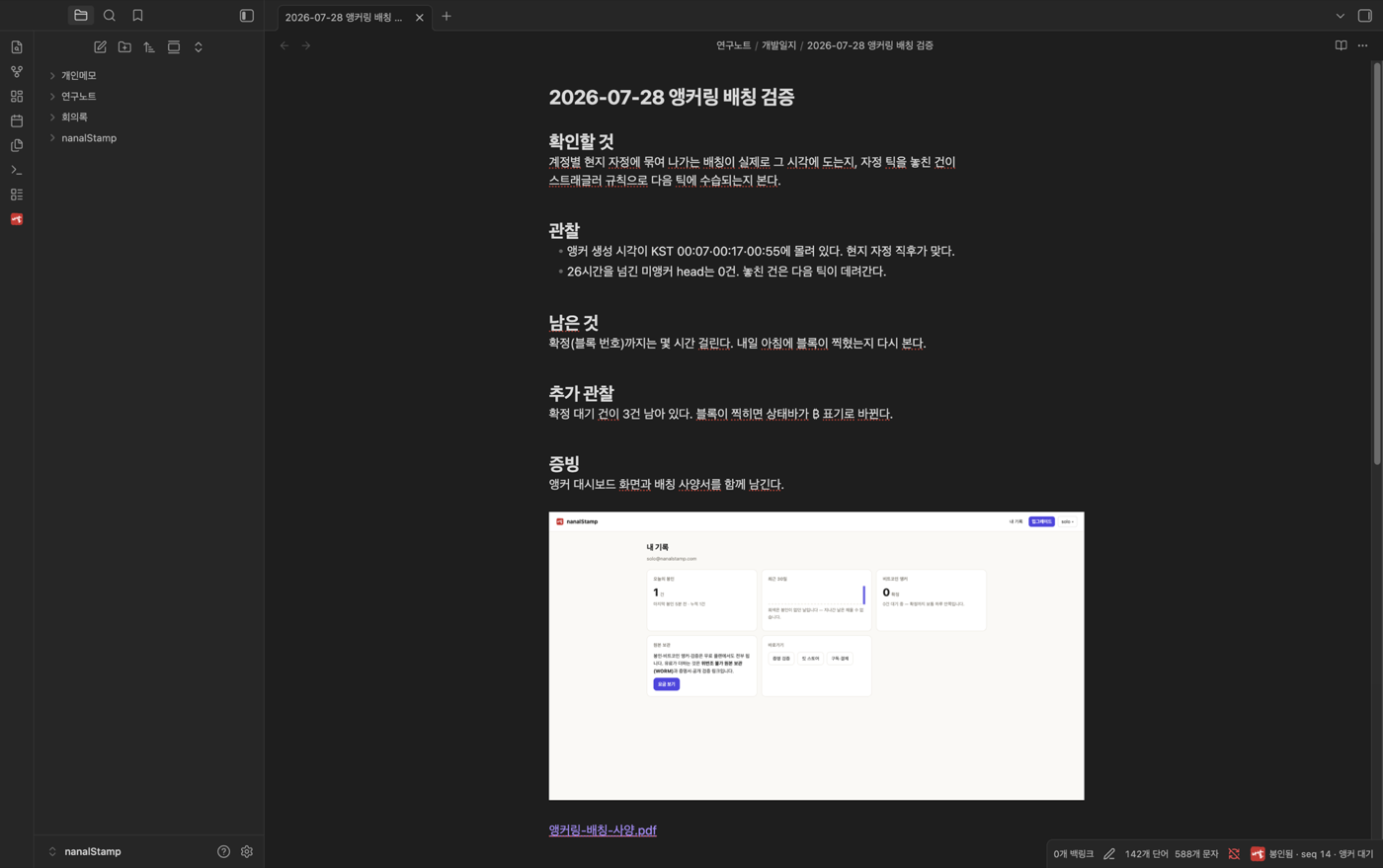
An entry time and sequence number recorded the moment of saving (nanalStamp) — the "backdating" problem disappears structurally when the system writes the date instead of the hand. The electronic requirements are covered in the requirements post.
The mistakes to check for, one last time
- Failed experiments unrecorded → record failures too
- Batch-writing a week at once → daily, chronological
- Correction fluid → two lines, sign, date
- Reviewer signatures collected in bulk → sign on the recording cadence
- Pasted memo slips → write directly in the body