 nanalLabs Blog
"You should keep a lab notebook" is common advice, but it is surprisingly hard to find out what makes a notebook compliant. This post summarizes the requirements from the primary source — Korea's National R&D Research Note Directive (in Korean) — and then tests everyday tools against them. Regulations change, so always check the original before relying on it.
Why lab notebooks matter
A lab notebook is not a memo — it is legal and administrative evidence, in three situations:
- Government-funded R&D — under Korea's National R&D Innovation Act framework, research notes are the baseline evidence of how work was performed; if misconduct is alleged, they decide whether it was done in good faith.
- Patent disputes and prior-use rights — "we were building this first" carries no weight without objective, dated records (see the prior-use post).
- Technology transfer and trade secrets — what was created, when, by whom: the starting point of valuation and protection.
The three requirements
The directive divides research notes into paper and electronic, and requires electronic notebooks to provide:
| Requirement | Meaning |
|---|---|
| Signature authentication of author and reviewer | Who wrote it, who checked it — electronically verifiable |
| Automatic recording of entry date and time | Timestamps recorded without human hands |
| Tamper detection | Later alterations must be detectable |
All three converge on one principle: the record must be impossible to fabricate after the fact.
Do everyday tools pass?
| Tool | Auto timestamps | Tamper detection | Note |
|---|---|---|---|
| Word/HWP file + hand-typed date | ❌ | ❌ | Date and content editable anytime |
| Shared cloud docs | △ modified-time only | ❌ | History exists but admins can purge it; no third-party verification |
| Emailing yourself | △ | △ | Header-forgery arguments, manual per file |
| In-house server timestamps | ✅ | △ | Self-certification — weak in a dispute |
| External anchors (RFC 3161 TSA, blockchain) | ✅ | ✅ | Independently verifiable by third parties |
A diligent lab using a tool from the top of this table still has no way to prove, at dispute time, that the records weren't written later.
What about paper notebooks?
Still valid — the requirements just move into physical form: a bound book, numbered pages, indelible ink, author and reviewer signatures with dates. Tearing out or inserting pages leaves traces; the binding does what cryptography does for electronic notes. The daily overhead of hand-writing and counter-signing is why practice keeps shifting electronic. For the forms themselves, see the template post.
The gap for private-sector labs
Korea's public timestamp certification service serves institutions performing national R&D. A corporate lab without government projects is outside that infrastructure — it must arrange timestamping and tamper detection on its own. The patent office's trade-secret original-proof service registers individual files, but manually, per file — impractical for records that accumulate daily.
A self-check for your lab
- Are entry timestamps recorded automatically?
- If a record is edited later, does the edit show?
- Can author and reviewer be electronically authenticated?
- Can you prove all of this to a third party — externally verifiable, not your own server logs?
- Does that proof cover the whole record, every day — not just the one document under dispute?
The last two are the hardest. A timestamp on your own server is self-certification. The anchor has to live somewhere you cannot touch — an authority signature such as an RFC 3161 timestamp, or a public ledger such as a blockchain — before "even we cannot alter it" becomes provable. The two differ in character and cover each other's weaknesses — see the dual anchor.
For a concrete picture of "automatic timestamps + tamper evidence" on screen:
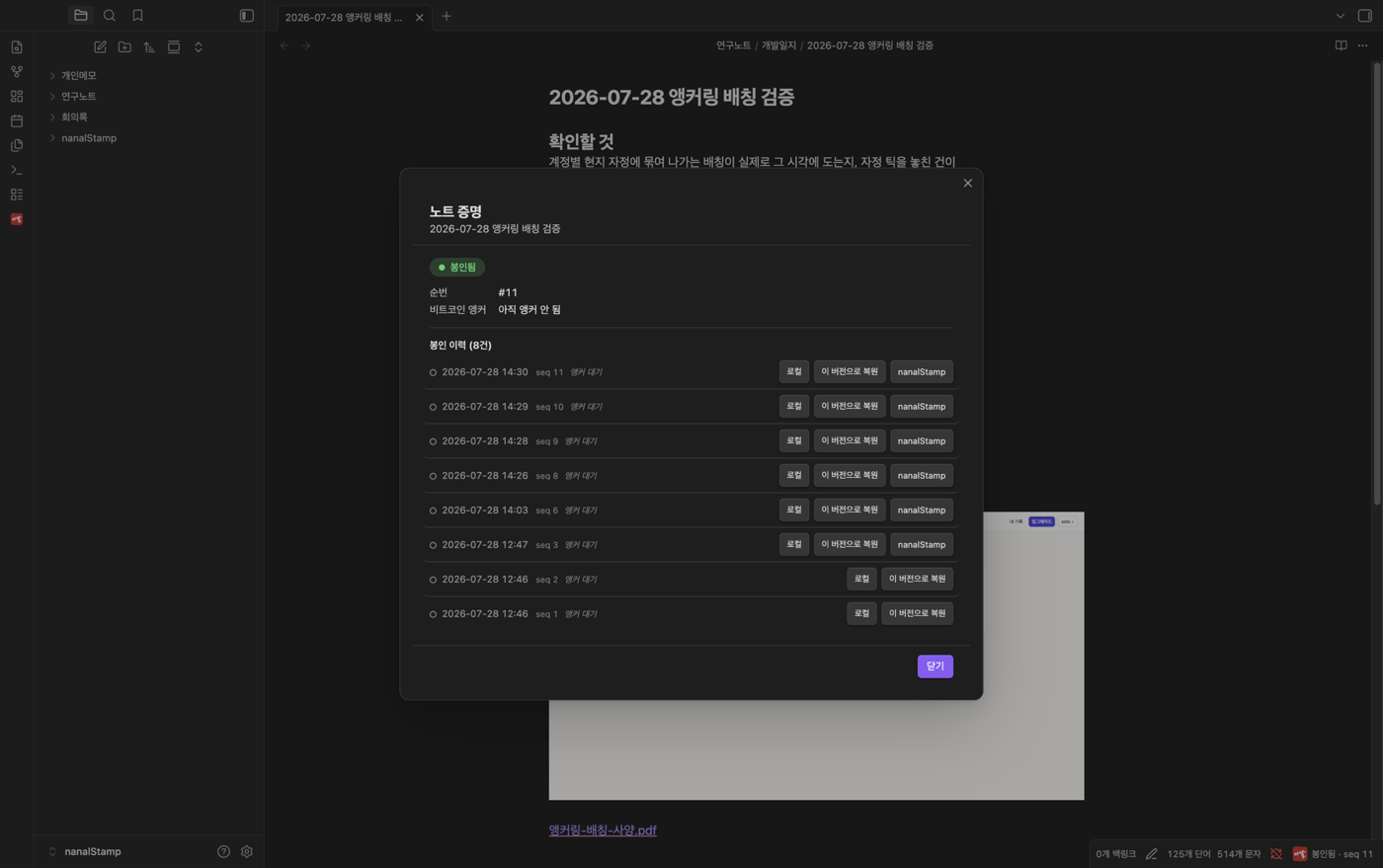
A note's record history (nanalStamp) — times, sequence numbers, and anchor status accumulating without human hands. Whatever tool you use, this is what the directive's requirements look like in practice.