 nanalLabs Blog
A recurring defense in patent disputes is the prior-use right. Article 103 of Korea's Patent Act (non-exclusive license by prior use) grants a party who was already practicing an invention — or preparing to — before someone else filed for it, the right to keep practicing within that scope (text, in Korean). Most patent systems have a comparable doctrine. For a company that protects its technology as know-how rather than filing patents, prior use is often the only line of defense.
The issue is always proof — what counts as evidence
A Korean patent office guide for small businesses (PDF, Korean), citing a 2006 Japan Patent Office report, lays out the evidence:
| Category | Examples |
|---|---|
| Technical documents | Research notebooks, technical reports, drawings, product specifications |
| Business documents | Business plans, launch decisions, estimates, delivery slips, daily work logs, product catalogs |
| Strengthening evidentiary force | Notarization (certified dates), private timestamps and electronic signatures, registered mail |
And it stresses: "create and preserve evidentiary records in the course of daily work, in a way that can prove when they were written." The claim itself is worth little; dated records decide the outcome.
What the original-proof service certifies — and what it doesn't
Trade-secret disputes have the same structure. Korea's original-proof service registers a digital fingerprint (hash) of a file; in a dispute it certifies existence, holder, and time of possession. In January 2025, three private organizations were additionally designated as certification bodies.
| It certifies | It does not certify |
|---|---|
| This file existed at this time | That the content qualifies as a trade secret (confidentiality management, value, non-disclosure) |
| The registrant at that time | That development was continuous |
| Today's file matches the registered one | The other prior-use requirements (actual practice or preparation) |
Neither trade-secret protection nor a prior-use defense follows from a certificate alone — the substance (plans, experimental records, logs) must exist alongside it.
Where practice breaks down
The original-proof service registers files one at a time. That works for a single document, but cannot keep up with records that accumulate daily — and prior-use evidence is precisely that: an unbroken timeline, not a snapshot. Everything converges on one question: do our daily records survive, in order, with verifiable timestamps, without gaps?
A checklist — before the dispute, not after
- Are development records (notebooks, work logs) kept daily, with dates?
- Can a third party outside your company verify those dates (notarization, timestamps, public ledger)?
- Is the record continuous — no holes in the timeline from conception to practice?
- Can you produce it in submittable form — documents and verification means an examiner or court can use?
On the last point: timestamped records should be producible in a form like this —
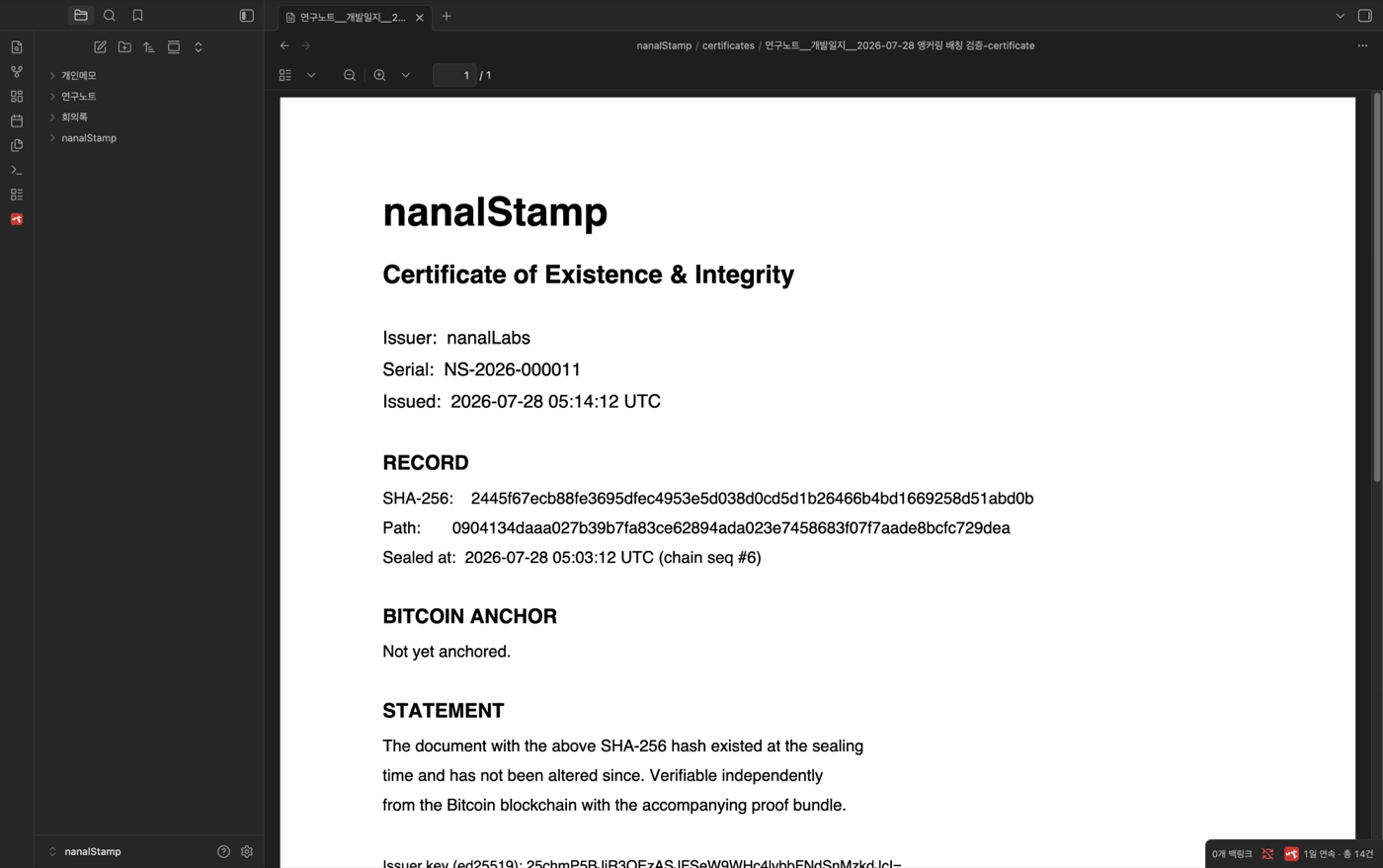
A certificate carrying the record's hash, time, and independent verification path (nanalStamp). Whatever method you choose, evidence only counts if it is ready to hand over.