 nanalLabs Blog
nanalStamp has two stages. Sealing chains and signs your note's hash on our server; anchoring fixes that seal into the Bitcoin blockchain. This post is about the second stage.
Why Bitcoin?
The weakness of any timestamp is the question "who vouches for this time?" Your own server's clock is self-certification — weak in a dispute. A timestamp authority (TSA, RFC 3161) is familiar to examiners and courts and confirms instantly, but requires trusting that authority's continued existence and key management. The Bitcoin blockchain needs no single company to trust and survives any company's disappearance — but takes hours to confirm and is unfamiliar to many practitioners. Because their weaknesses are exact opposites, nanalStamp anchors the same hash to both at once (the dual anchor) — an instantly-signed RFC 3161 timestamp plus an authority-free Bitcoin proof. If nanalStamp shut down tomorrow, "this hash existed as of this block" would remain verifiable by anyone as long as Bitcoin exists — and in an examination room, the familiar TSA signature explains itself.
Only hashes go onto the blockchain. Your note's content is never published anywhere.
When does anchoring happen?
Normally you do nothing. Each day's seals are batched at your local midnight and submitted to Bitcoin. Batching a day's worth, rather than submitting every seal individually, keeps costs down and confirmation predictable.
When you need it fixed right now — say, just before a submission — use ribbon → "Anchor to Bitcoin now."
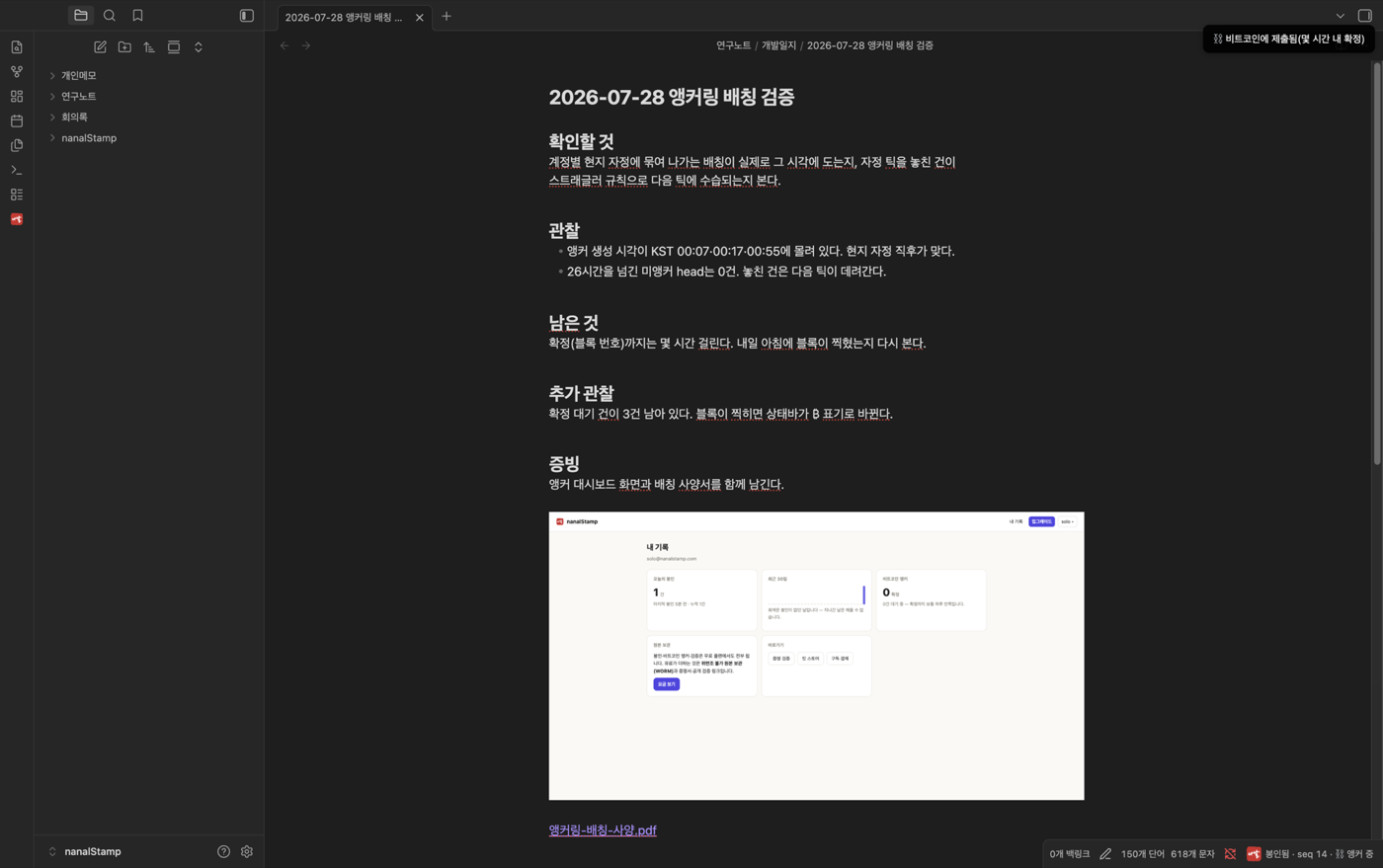
"⛓ submitted to Bitcoin (confirms within hours)" — the status bar switches to "anchoring."
Confirmation typically takes a few hours; once confirmed, the status bar and timeline show the block number.
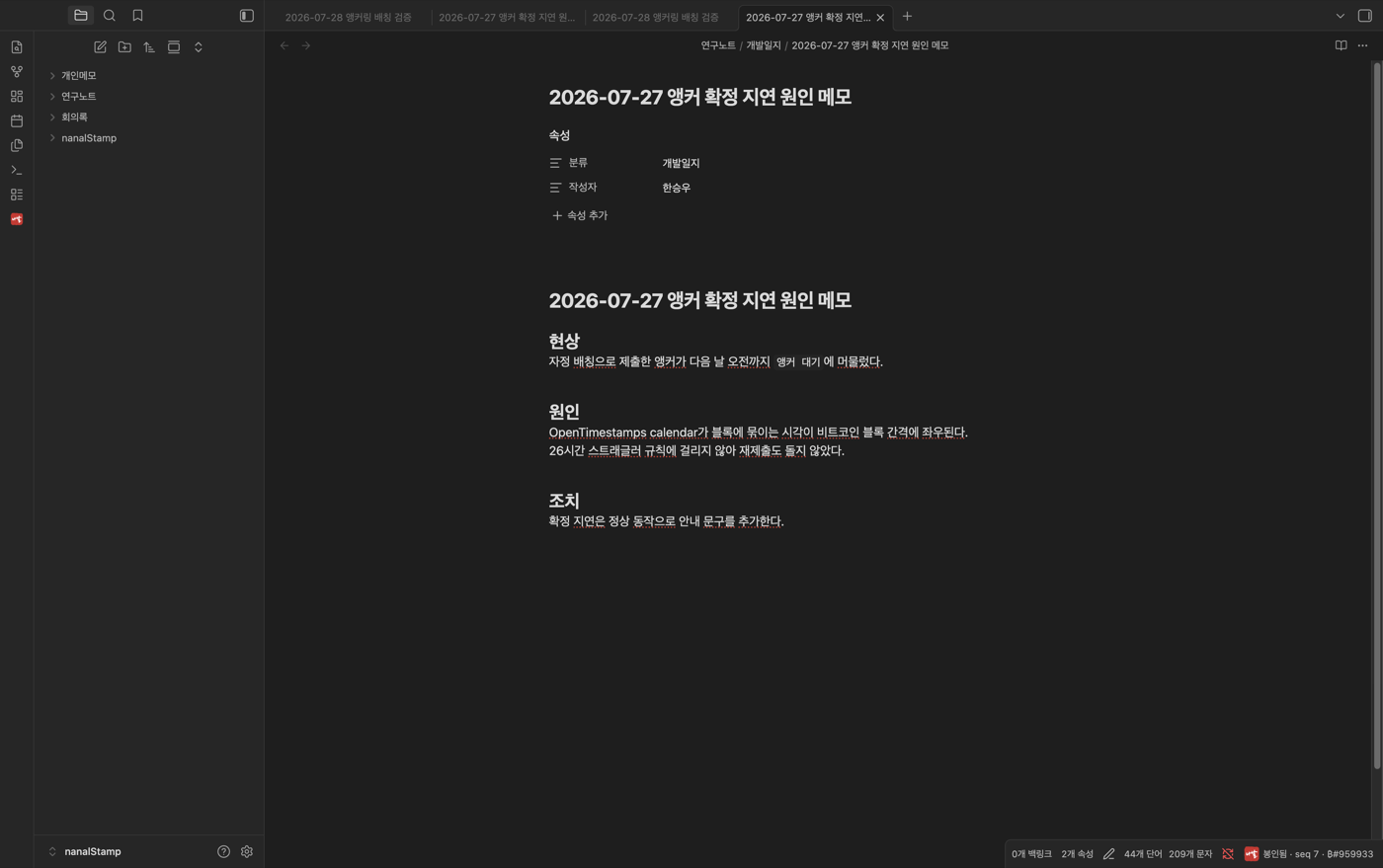
"Sealed · seq N · ₿#959933" — that block number is the coordinate of "unmodifiable after this point." Versions written after confirmation go back to "awaiting anchor" — every version is confirmed separately.
Verification is standards-based
Anchors are built on the open OpenTimestamps-style Merkle commitment scheme, so verification does not require nanalStamp's server. The Bitcoin evidence included in certificates and submission packages can be checked with standard tools. The point of this architecture is not "trust us" — it is "check for yourself."